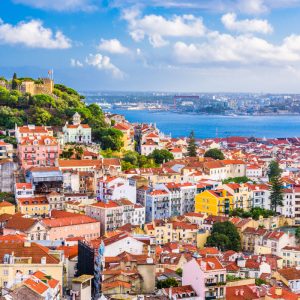
Take a walk through Lisbon’s historic streets and landmarks
Lisbon, Portugal, is one of Europe’s oldest capital cities. During the Roman Period, Julius Caesar liked the Lisbon area so much he granted the status of municipality and named it Felicitas Julia. Many centuries later in 1255, Lisbon officially became the Portuguese capital and since then has thrived as Portugal’s economic, financial and cultural hub.
1. Belém Tower
Belém means “Bethlehem.” For centuries, this tower has been a Lisbon landmark. It was built as a fortress in the 16th century, on a small island in Lisbon’s famous Tagus River. It became a symbol of Portugal’s maritime power during Europe’s Age of Discovery (approximately from the 15th to 17th centuries), and the point where Portugal’s explorers began and ended their journeys.
2. Jerónimos Monastery
Along with the Belém Tower, Jerónimos Monastery was made a UNESCO World Heritage site in 1983. Its construction started in 1501 and was completed 100 years later. It was built close to the place where Portuguese explorer Vasco da Gama set sail for India. The monastery was once home to monks, of the Order of St. Jerome. Today, it is a tourist hot spot and the final resting place of Vasco da Gama.
3. São Jorge Castle
Visitors can enjoy stunning views of Lisbon from São Jorge Castle, which stands on a hill. The history of the castle and fortress goes back to the 10th century when Lisbon was still under the rule of the Moors. São Jorge Castle went through a number of renovations following ruler changes and earthquakes. It became a royal residence for the Portuguese royal family in the 13th century.
4. Praça do Comércio
Translated as “commercial square,” this is Lisbon’s historic city plaza on the banks of the Tagus River. Lisbon kings, merchants, nobles and locals gathered here for centuries. Before a big earthquake in 1755, the Ribeira Palace, the residence of the Portuguese royal family, stood here. Today, the plaza is home to several of Portugal’s important government offices.